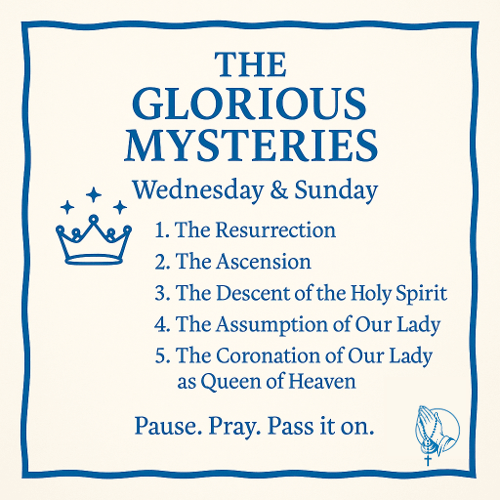
• Where the Joyful Mysteries announce the promises of Christ, the Glorious Mysteries reveal their fulfilment. They proclaim God’s victory over sin and death and remind us of the destiny that awaits those who remain faithful to His truth.

    For me, the Glorious Mysteries are both a call to mission and a reassurance that we are never alone in it. The Resurrection is the foundation of our hope: death — the price of Original Sin — has been conquered once and for all. The Ascension directs us outward, as Christ entrusts His mission to His disciples. The Descent of the Holy Spirit sustains the Church and gives us courage. And in the Assumption and Coronation, we see Mary — the New Eve — sharing in her Son’s glory and interceding for us as Queen of Heaven.

    Together, these Mysteries teach hope and mission — personal and communal. My own faith is strengthened by knowing I belong to something greater than myself: the whole Body of Christ. I often reflect here on the words of St. Teresa of Avila: “Christ has no body now on earth but yours, no hands but yours, no feet but yours. Yours are the eyes through which Christ looks with compassion on the world.” The Glorious Mysteries remind me that my role is not passive. Christ offers me hope of eternal life, but He also calls me to imitate His life and bring His love to others.

    That mission is not always about preaching. It is about living Christ: loving my neighbour as myself, remembering that He died for all as surely as He died for me. This is often hardest when I am in deep disagreement with someone, or when I feel anger and even hatred rising in my heart. But the Glorious Mysteries draw me back to the truth that salvation is for all — even those I find most difficult to love. Only God sees the heart. What appears objectionable in another may come from a place of pain or vulnerability.

    Even in Scripture, God shows patience. When Moses came to Pharaoh with the cry, “Let my people go,” Pharaoh’s heart was not hardened at once. God gave him chance after chance. The Resurrection and Ascension challenge me to do the same — not to divide the world neatly into those with whom I agree and those I condemn, but to remember that Christ’s mission is for every soul.

    This is not easy. But discipleship was never meant to be easy. The Glorious Mysteries remind us that what is difficult is also what is most necessary: to carry hope into the world, to live the mission entrusted to us, and to believe that Christ’s victory is for all.

    Pause. Pray. Pass it on.
  • The Hail, Holy Queen — or Salve Regina — is one of the two concluding prayers of the Rosary. Both centre on Mary, the Mother of God, as the one who intercedes for us, prays with us, and leads us to her Son. In these prayers we ask to be “made worthy of the promises of Christ” — the very promises contained within the Mysteries we have just meditated upon.

    The Salve Regina is traditionally attributed to Hermann of Reichenau, an 11th-century Benedictine monk. Like the Hail Mary, it has become both a liturgical centrepiece and a prayer deeply embedded in the Church’s devotion, carried in song from the simplicity of Gregorian chant to the splendour of orchestral settings. While Our Lady is the focus, the prayer ultimately reflects our condition as exiles from Eden and highlights her role as the New Eve — the one who, through her obedience, offers the antidote to sin.


    The prayer names us as “poor banished children of Eve.” We come to Mary conscious of our inheritance: through pride and sin, we are separated from the Trinity. Life itself is marked as exile — “mourning and weeping in this valley of tears.”

    This is crucial: it acknowledges that we are not made for this state. We are seeking something greater. The Salve Regina gives language to that universal ache: “to thee do we send up our sighs.”

    Every human being feels this need. The darkness within us often drives us toward coping mechanisms — depression, isolation, addiction — all ways of filling the void of exile. This is not only the legacy of Eve’s sin but also our own daily choices to continue in sin. We remain “children of Eve,” but our exile is not only inherited; it is chosen.


    And so we turn to Mary, our advocate. We beg her to turn her “eyes of mercy towards us.” Notice what we ask: not for instant rescue, but for mercy. Mercy recognises both our weakness and our freedom: that our pain is not simply imposed upon us, but shaped by our own choices. We ask her to lead us, to guide us, to bring us to Christ — both now in faith, and ultimately when our exile ends.

    The prayer closes with a cascade of affection: “O clement, O loving, O sweet Virgin Mary.” In these words we both honour Mary and appeal to her prayers. We ask again to be made worthy of the promises of Christ — acknowledging that in ourselves we are not, yet trusting that Christ’s promises are offered freely nonetheless.


    By the end of the Rosary, it is tempting to rush through the closing prayers. Don’t. Take your time. These prayers gather together all we have meditated on — the mysteries of Christ’s Passion and Resurrection, our own frailty and sin, our need to be held and led into the arms of the Lord.

    The Salve Regina reminds us of who we are: exiles longing for home, children of Eve who look to the New Eve, praying for her mercy as we journey toward Christ.

    Pause. Pray. Pass it on.

  • Before turning to the Mysteries themselves, there is one last prayer to consider: the Closing Prayer of the Rosary. Most common in English-speaking traditions, it follows the Salve Regina and serves as something of an “addendum.”

    Where the Salve Regina grounds us in Mary’s intercession and maternal care, the Closing Prayer directs us back to God in our own petitions. It reminds us that praying the Rosary does not complete our task — it begins it. The Rosary is a foundation, a springboard into life as an act of faith.

    The prayer begins by proclaiming the very centre of Christian belief: “O God, whose only-begotten Son, by His life, death, and resurrection, has purchased for us the rewards of eternal life.” These words root us once more in the Paschal Mystery — the Incarnation, Passion, and Resurrection of Christ — and affirm that our salvation flows from these saving events. From beginning to end, the Rosary is anchored in this truth.

    Having recalled it, the prayer shifts to petition: “Grant, we beseech Thee, that meditating upon these mysteries of the most holy Rosary of the Blessed Virgin Mary, we may imitate what they contain, and obtain what they promise.” Here lies the heart of the Closing Prayer. It is not enough to recite the prayers or to meditate on the Mysteries; the Rosary calls us to transformation. To imitate in order to obtain. Having contemplated Christ’s life, we are now sent to live it — to bring the Kingdom nearer through our own actions, words, and choices. Eternal life is not only a distant hope; it begins now, in daily faithfulness, in each thought and deed aligned to Christ.

    This prayer leaves us no room for complacency. Faith is not something half-hearted. I often say that I cannot understand “lukewarmness” in faith — though I know I am guilty of it often enough. But the truth remains: faith is either everything or it is nothing. If God is real, if Jesus is truly who the Gospels proclaim Him to be, then it is all that matters. The Closing Prayer of the Rosary drives this point home: prayer must become life, meditation must become imitation, and the mysteries we ponder must take root in how we live.

    Pause. Pray. Pass it on.

  • The Fatima Prayer is not an official part of the Holy Rosary, yet it is often prayed at the end of each decade. Revealed by Our Lady to the three shepherd children at Fatima in 1917, the prayer is sometimes surrounded by controversy because of its origins. But whatever one makes of the visions, the prayer itself remains simple, profound, and powerful.

    Our Lady instructed the children to add this prayer to their Rosary after showing them a vision of hell. It was not primarily a plea for their own salvation, but for the salvation of those most forgotten by the prayers of the living. The text of the prayer holds together a personal confession and a universal intercession:

    “O my Jesus, forgive us our sins, save us from the fires of hell, lead all souls to Heaven, especially those most in need of Thy mercy.”

    At its heart, the Fatima Prayer reminds us that all prayer is rooted in repentance. Even praise and thanksgiving flow from the recognition that the graces we receive are not deserved by our own merit but given through God’s mercy. It echoes the truth of John 3:16: “For God so loved the world, that He gave His only Son, that whoever believes in Him should not perish but have eternal life.”

    It also recalls Christ’s own words in the Lord’s Prayer: “…and forgive us our trespasses, as we forgive those who trespass against us” (Matthew 6:12). The common thread is both personal and universal: the intimacy of “O my Jesus” alongside the breadth of “save us from the fires of hell.” We are never isolated in our prayer — we are connected to the whole Church.

    The closing petition — “Lead all souls to Heaven, especially those most in need of Thy mercy” — challenges us to see ourselves in that plea. We are all in need of God’s mercy. But it also reminds us to pray for those forgotten by others, those who have no one left to intercede for them. At Fatima, the shepherd children were asked to pray for souls in anguish for whom no one prays. That reminder is both sobering and hope-filled: our prayers matter.

    In this way, the Fatima Prayer aligns with the penitential prayer at Mass: “…and you, my brothers and sisters, to pray for me to the Lord our God.” Our faith is never private. We rely on the prayers of one another, of the saints, of the whole Church across time and space. And we are called to remember in prayer those who cannot, or will not, pray for themselves.

    Pause. Pray. Pass it on.

  • There are two dimensions to every Rosary — the body and the soul.

    The body consists of the physical act of prayer: the recitation of the Our Father, Hail Marys, Glory Be, and Fatima Prayer. It gives the Rosary its structure, rhythm, and pace. The body measures the time we spend in prayer and provides the grounding repetition that carries us forward.

    The soul is the meditation on the Mysteries — scenes from the life of Christ, contemplated through the eyes of Our Lady. The soul draws our attention to the life, death, and resurrection of Christ, allowing each decade to become a window into His saving work.


    A frequent criticism of the Rosary is that Christ Himself warned against repetitive prayer: “And when you pray, do not heap up empty phrases as the Gentiles do; for they think that they will be heard because of their many words” (Matthew 6:7).

    The key is in those words: “do not heap up empty phrases.” Jesus does not condemn repetition itself — indeed, He repeats His own prayer in Gethsemane (Matthew 26:44). What He forbids is mindless babble, the idea that many words alone can manipulate God.

    The Rosary’s repetition is not empty. Its body provides a tangible rhythm that steadies the mind, quiets distractions, and makes space for meditation. The prayers themselves turn our hearts toward God while asking Our Lady to keep us attentive to the Mysteries. When our thoughts wander, the rhythm draws us gently back to the purpose of prayer.


    Through the soul of the Rosary, we step into each of the five Mysteries. There are many ways to meditate:

    • Through the eyes of Christ.
    • As an observer.
    • Or through the eyes of Mary — a perspective that can be especially powerful.

    As a parent, I find meditating on the Sorrowful Mysteries from Mary’s perspective almost overwhelming: to imagine her watching her Son suffer and die is profoundly humbling.

    There are many excellent guides to assist meditation. I often use Rosary Meditations by Amy Troolin, or the Rosary “pray-alongs” available on the Hallow app — Jonathan Roumie’s Scriptural Rosary and Bishop Barron’s reflections are particularly helpful.

    Visual images can also be powerful aids. Icons, sacred art, or depictions of the Mysteries can draw our focus more deeply into the scene. For me, this is especially helpful: instead of struggling to picture details in my mind, an image helps me concentrate on the heart of the Mystery.

    Body and soul. Without both, the Rosary risks becoming a prayer of repetition to nowhere. With both, it becomes a prayer of presence and transformation.

    There will be frustrations — moments when meditation is difficult, or a line of prayer is lost. Accept them. Focus instead on what matters most: meditating on the Mysteries of Christ through Mary, in the hope of imitating what they contain and obtaining what they promise.

    Pause. Pray. Pass it on.

  • The Glory Be is said at the conclusion of the introduction to the Rosary and at the end of each decade. It is a doxology — a liturgical form of praise. Placing it at the end of each stage of the Rosary draws our attention back to the glory of God. Wherever our reflection or meditation has taken us, the Glory Be re-centres us before we move to the next Mystery.

    It is a doxology in three parts. It begins with: “Glory be to the Father, and to the Son, and to the Holy Spirit” — naming each Person of the Trinity individually and equally. The prayer reminds us that all glory belongs to the Father, Son, and Holy Spirit alike. In my own meditations, I sometimes struggle to hold the Trinity in balance. Too often, I find myself neglecting the Holy Spirit. The Glory Be reminds me that each Mystery is the work of the whole Trinity: designed by the Father, fulfilled by the Son, and brought to our remembrance by the inspiration of the Holy Spirit.

    The prayer continues: “As it was in the beginning, is now, and ever shall be.” These words affirm God’s eternal glory — past, present, and future. “In the beginning” recalls both Genesis 1, where God creates the heavens and the earth, and John 1, where “the Word became flesh.” God’s glory exists outside time and space; it is eternal. For me, this is deeply consoling. In moments of vulnerability or loneliness, the words “ever shall be” remind me that God holds past, present, and future in His hands. Even when I cannot see the path ahead, I can trust that He sees it clearly.

    The prayer concludes: “…world without end. Amen.” This phrase affirms God’s everlasting reign. The Latin original (in sæcula sæculorum) literally means “unto the ages of ages” — an endless stretch of time. Here we proclaim that God’s kingdom has no end, and that in Christ’s victory over sin and death, eternal life is offered to us.

    When the Glory Be is prayed at the end of each decade, it reminds us that all the Mysteries of the Rosary — indeed, all of Scripture — form one continuous story of salvation. The Bible does not close with finality but with promise: the promise of Christ’s return, the fullness of the Kingdom, and eternal communion with God.

    Pause. Pray. Pass it on.

  • The Hail Mary is the most repeated prayer in the Rosary. Indeed, the Rosary itself is dedicated to Our Lady, and I often return to St. Padre Pio’s words: “In times of darkness, holding the Rosary is like holding Mary’s hand.” For such a short prayer there is so much to say, especially about the three Hail Marys at the beginning of the Rosary, that it is hard to know where to begin.

    Rather than deconstructing the prayer line by line here (something I will save for later), I want to address a central question that many — myself included — have wrestled with: do prayers to Our Lady distract from Christ? Is this worship of Mary rather than devotion?

    I do not intend to dive deep into apologetics here. There is already an overwhelming amount of content on this subject, and I have little new to add to it. Instead, I simply encourage those who have even a faint light of faith to lean into it, especially in times of need.

    For me, what deepens faith is experience. On at least three occasions of great need, I turned to Our Lady in prayer through the Memorare, begging for her intercession, and I was never left unaided. That kind of lived experience has shaped my devotion more than reading or hearing arguments. Perhaps it makes me ill-suited to apologetics, but it has convinced me of her maternal care.

    Scripturally, the logic of asking for Mary’s intercession is clear enough. St. Paul, in his letters, reminds us that the Church is one body in Christ (Romans 12:4–5; 1 Corinthians 12:12–27). Revelation portrays the prayers of the faithful rising before God through heavenly beings (Revelation 5:8). Death does not cut the saints off from the Church — they remain alive in Christ, bound to Him and therefore bound to us. If we ask one another for prayer on earth, how much more can we call upon the saints who now see God face to face? Far from distracting from God’s glory, their prayers help us focus on Him with greater precision.

    Mary, however, is unique. God chose her to bear His Son, to carry Him in her womb, and to raise Him as her child. In this sense she is rightly honoured as Mother of God. Revelation speaks of her crowned in heaven (Revelation 12:1). Prayer to Mary, then, is not worship, but a request that she lead us to Christ — just as she first delivered Him to us on earth.

    And the Hail Mary itself is profoundly Christ-centred.

    • “Hail, Mary, full of grace, the Lord is with thee” — Gabriel’s greeting at the Annunciation (Luke 1:28). It is regal, honouring her unique fullness of grace.
    • “Blessed art thou among women” — Elizabeth’s words at the Visitation (Luke 1:42). Mary is chosen as the New Eve, prepared to bear the antidote to sin.
    • “And blessed is the fruit of thy womb, Jesus” — the heart of the prayer. Mary is blessed because she bore Christ, the true focus of our devotion.

    Mary’s greatness is her obedience: “Behold, the handmaid of the Lord. Be it done unto me according to your word” (Luke 1:38). She is full of grace not for her own sake, but because she gave herself wholly to God. In asking her to “pray for us sinners, now and at the hour of our death,” we ask her to accompany us and to keep our gaze fixed on Christ.

    The three Hail Marys at the start of the Rosary are prayed for the virtues of faith, hope, and charity. We pray for faith like Mary’s at the Annunciation, hope in God’s promises like hers at the Visitation, and charity like hers in the whole of her life.

    The Hail Mary is not a distraction from Christ but a path to Him, prayed hand-in-hand with the one who most perfectly followed Him.

    Pause. Pray. Pass it on.

  • Continuing with the theme of prayers at the start of the Rosary that we pray so often they can lose their meaning — after the Sign of the Cross and the Apostles’ Creed comes the Our Father.

    I went to a Church of England Infant School and a secular Junior School. Shine, Jesus, Shine and the Our Father were staples of every assembly. It was the first prayer I knew, and it is often one of the first prayers any of us learn. Yet because we learn it as children, it is easy to miss its depth. Too often we hold onto it only as “the prayer that Jesus gave us” without entering into the meaning of its words.

    The story of its origin is simple: the disciples, often confused and unsure, asked Jesus how they should pray. And He gave them the Our Father. That alone gives us the foundation of all prayer — Christ Himself teaching us how to lift our hearts to God.

    I’ll return in future posts to break down the individual lines of this prayer, but for now I want to share how I use it in my own prayer life. I find it hard to pray “freestyle.” Many times I’ve gone into a church with a deep need in my heart, lit a candle, made the Sign of the Cross… and then nothing. My thoughts either crowd in all at once or vanish completely.

    In those moments, I imagine myself sitting on a bench next to Christ, and I begin the Our Father. Between each line, I pause and expand on the theme. Sometimes I reflect on all of the lines, sometimes on just one. Either way, the prayer becomes a doorway into conversation with God.

    Here is an example reflection I wrote down during prayer, showing how the Our Father can open into personal dialogue with God:


    Our Father,
    (God, You are my Father — the Father of all. You love me, and You love everyone equally. I pray even for those who wish me ill, because You love them as much as You love me.)

    Who art in heaven,
    (You are my Father, but You also transcend all things. You are both personal and eternal. I place my trust in You.)

    Hallowed be thy name,
    (Use my life to glorify You. Help me to listen for Your plan and live in a way that hallows Your name on earth.)

    Thy kingdom come, thy will be done,
    (Where my desires conflict with Your will, give me the strength to surrender. “Lord, I believe — help my unbelief.”)

    On earth as it is in heaven,
    (Help me to fulfil Your plan for me, and help me support others in theirs, so that Your kingdom may grow closer each day.)

    Give us this day our daily bread,
    (Sustain me in body and soul. Teach me to trust in Your providence, and free me from anxiety over worldly concerns.)

    And forgive us our trespasses,
    (You give me everything, yet I still stray. Forgive me for my failures, for turning from You.)

    As we forgive those who trespass against us,
    (Remind me that You have forgiven me far more than I am asked to forgive. You suffered for my redemption; help me to forgive others out of love for You.)

    And lead us not into temptation,
    (My will for You is strong, but I am weak. I turn to worldly comforts instead of trusting in You. I cannot resist temptation alone — strengthen me.)

    But deliver us from evil,
    (Though I stumble, I choose You. Help me see You in every trial and choose rightly, so that even my setbacks glorify You and deepen my faith.)

    Amen.


    The Our Father is the perfect “Pause. Pray. Pass it on” prayer. We already know it by heart, yet its lines can open new paths of reflection every time we pray. It is not just the prayer that Jesus gave us — it is the prayer that can carry us back to Him, again and again.

    Pause. Pray. Pass it on.

  • As with the Sign of the Cross, the Rosary begins with a prayer so familiar that its repetition can sometimes dull our awareness of its true depth. Perhaps nowhere is this more the case than with the Apostles’ Creed. Line by line, it tells the most remarkable story ever told. If you hold its words in your heart, you find yourself at the very centre of that story. The events it proclaims did not happen in some remote or disconnected place — they happened because God loves you.

    A creed is a formal statement of faith. Like stained glass windows, statues, or icons, it is a way of passing on the truth rapidly, accurately, and accessibly, even to those who cannot read Scripture themselves. From the 2nd century onward, Christian communities shared centralised creeds to unite themselves in the truths of the faith.

    By the 4th century, a legend arose that each of the Twelve Apostles had contributed one line to this shared profession. Hence the name: Apostles’ Creed. Whether literal or symbolic, the story reminds us of something the Creed itself contains — our belief in the Holy Catholic Church, in apostolic succession, and in our belonging to the Church Christ founded when He entrusted His mission to St. Peter.

    The Apostles’ Creed is above all a profession of faith. It is a concise summary of the Gospel and of the whole biblical story: though humanity strays, God always has a plan to draw us back to Himself. It is our faith in miniature.

    It also binds us to the Church. In every age, Christians have been tempted to use Christ and His message to support their own purposes or politics. The Creed is a corrective, calling us back to the centre. In speaking it aloud, we align ourselves with the teaching of the Catholic Church, with the Apostles and their successors, and with one another. What begins as a personal prayer is lifted into the voice of the universal Church.

    Each line of the Creed holds depths for meditation. Some phrases appear directly as Mysteries of the Rosary — “He was crucified, died, and was buried.” Others, like “He descended into Hell,” open more challenging grounds for contemplation. In this way, the Creed sets the stage for the Rosary as a whole, orienting our minds before we enter into the particular Mysteries.

    The Creed also steadies us in times of doubt, what St. Ignatius and others call spiritual desolation. It gives us a framework: an “if A, then B” pattern of faith. Perhaps I struggle to comprehend the Resurrection. But when I proclaim “was crucified, died, and was buried” and then “I believe in the communion of saints,” I recall two undeniable truths: Christ was certainly crucified, and the earliest Christians were certainly martyred for proclaiming His Resurrection. If A, then B.

    So when we begin the Rosary and recite the Apostles’ Creed, it is not mere preamble before the “main event.” It is the foundation, the very reason we pray. It grounds us in the promises of Christ — the same promises we ask to be made worthy of when the Rosary concludes.

    Pause. Pray. Pass it on.

  • The Rosary, like almost all prayer in the Catholic faith, begins with the Sign of the Cross. It is a short, simple gesture we often make by habit — yet it carries profound meaning.

    In the early Church, this action was known as the “Seal of Christ.” Believers would often trace a small cross on the lips or forehead. Between the 1st and 6th centuries, this discreet movement gradually became the fuller gesture we know today. The change was not stylistic but circumstantial: as long as Christians faced persecution, the Cross had to be hidden. By the 4th century, after the Emperor Constantine made Christianity the faith of the Roman Empire, the Sign of the Cross could be made openly. What was once sheltered became a bold witness to belonging to Christ.

    Today, when we make the Sign of the Cross, we invoke the Holy Trinity and place ourselves and our prayer before God. It is a physical reminder that we are entering into communion with the Divine: Father, Son, and Holy Spirit. With this gesture, our mind, heart, and body are turned toward Him, focused on the words we are about to pray.

    The sign also recalls our Baptism. At the font, the priest marked us with the Cross, sealing us as God’s own. Each time we repeat the gesture, we are drawn back into that “one baptism for the forgiveness of sins,” reaffirming the covenant that began our Christian life.

    From the earliest centuries, Christians also saw the Cross as a mark of protection from temptation and evil. Tertullian, the first Latin Christian theologian, wrote: “At every forward step and movement, at every going in and out… we mark our foreheads with the sign of the cross.” In making the sign, we place ourselves in the care of the Church across all ages. We bind ourselves to the saints who have gone before us, asking for the strength and will to follow their example.

    Finally, to begin and end prayer with the Cross is to place everything within the mystery of our salvation. It reminds us of Christ’s command to take up our cross and follow Him; of the price already paid for our sins; of the suffering He bore for our redemption. It turns our hearts back to the words of John’s Gospel: “For God so loved the world that He gave His only Son” (John 3:16).

    The Sign of the Cross may take no more than three or five seconds. We may make it thousands of times in our lives, and it risks becoming routine. Yet we should never lose sight of its weight and its privilege. We live in a time when we can make this gesture without fear of persecution — without fear of stones or death. Each time we cross ourselves, we are joined to the Church of the ages, strengthened by its saints, and contributing to the legacy of those who will come after us. Above all, we turn our mind, body, and soul toward the incomprehensible sacrifice made for our salvation.

    In the name of the Father, and of the Son, and of the Holy Spirit. Amen.

    Pause. Pray. Pass it on.